
Building a long-term agroforestry system rooted in soil health, water efficiency, and perennial resilience.
Designed for the Long Term
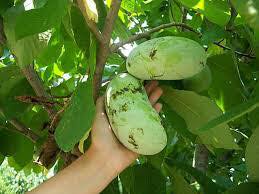
Our farm is being established as a perennial agroforestry system, with planting beginning in spring 2026. From the start, the goal has been to build a farm that improves over time rather than one that depends on constant rebuilding each season. Trees, shrubs, and permanent ground cover are arranged intentionally to support soil health, efficient water use, and long-term resilience across South and Central Wisconsin.
Unlike annual production models that rely on repeated soil disturbance, our approach prioritizes long-lived crops with deep and diverse root systems. These roots help stabilize soil, improve water infiltration, and support soil biology as the system matures. This long-term thinking guides our Orchard Design / Agroforestry Vision, where spacing, crop selection, and layout are planned decades ahead rather than year by year—an approach well suited to farms serving the greater Madison area and surrounding rural communities.
Because perennial systems take time to establish, productivity unfolds gradually. Some crops will come into production sooner, while tree crops are designed for long-term yields. We share these expectations openly through our Harvest Calendar, so visitors across the greater Milwaukee area and the Upper Midwest understand not just what we grow, but when those crops are expected to be available.
By focusing on perennial agriculture, we are building a farm rooted in patience, durability, and stewardship. When you Visit the Farm, you’re seeing an early stage of a system designed to grow stronger, more resilient, and more productive with each passing year—one built to serve our local region for generations.
The choices we make today are meant to support the land, the crops, and the people it serves.
Permanent Living Ground Cover
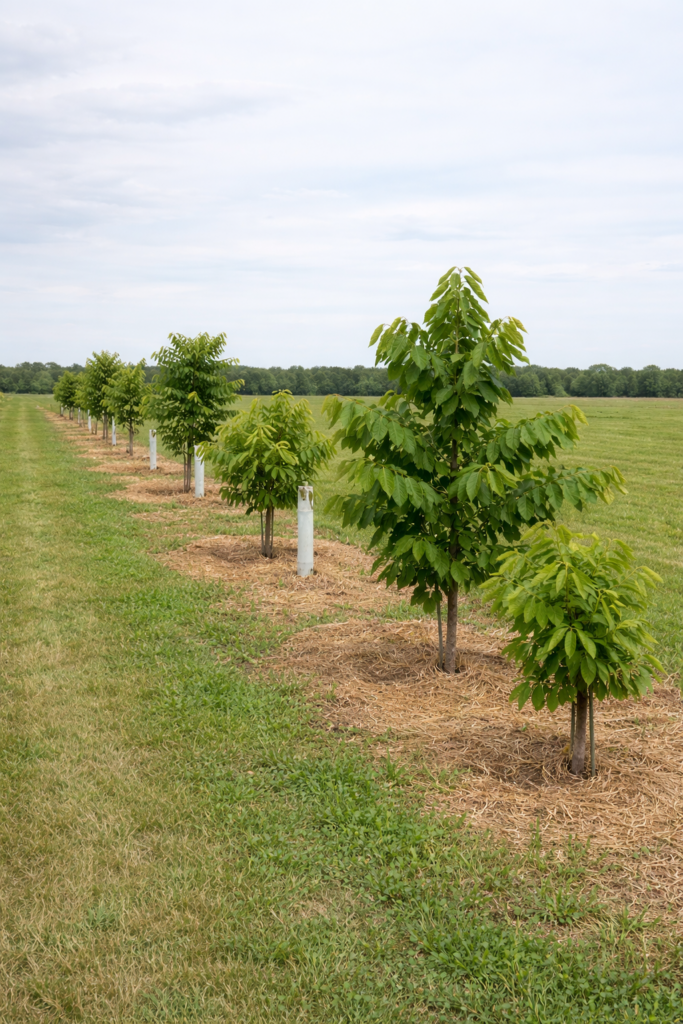
From the beginning, our farm has been designed around permanent living ground cover rather than seasonal soil exposure. Instead of treating bare soil as a starting point each year, we focus on keeping roots in the ground to protect structure, support soil biology, and improve water movement across the landscape.
As a result, our rows are established with a diverse, low-growing cover crop mix intended to remain in place long term. This approach helps reduce erosion, moderate soil temperatures, and suppress weeds naturally. In addition, living ground cover feeds soil microbes continuously, supporting healthier fungal and microbial communities as the perennial system matures.
Because our farm relies on a no-till establishment strategy, permanent cover plays an essential role in maintaining soil integrity. Rather than disturbing soil repeatedly, we allow plant roots, microbes, and organic matter to do the work of building structure over time. This method aligns closely with the principles behind our Orchard Design / Agroforestry Vision, where soil health is treated as a foundational asset rather than a variable input.
Over time, this ground cover also improves how water moves through the farm. Rainfall is absorbed more efficiently, runoff is reduced, and moisture is retained longer during dry periods. Consequently, this supports our broader water-efficient approach and complements the micro-irrigation system used throughout the farm.
Permanent cover crops are widely recognized as a core component of regenerative and agroforestry systems, including guidance outlined by the USDA Agroforestry Overview. However, rather than following a generic formula, we’ve selected and managed ground cover specifically to support our perennial crops and long-term goals.
Ultimately, living ground cover allows the farm to function as a system instead of a series of inputs. It supports the health of crops like Aronia, Hazelnut, and Honeyberry, while quietly improving soil conditions season after season as the farm continues to establish.
By keeping living roots in the soil, the farm gains stability, efficiency, and resilience as the perennial system continues to mature. Visit our blog for articles on elderberry health benefits, preservation tips, recipe inspiration, and seasonal harvest updates.
No-Till Establishment & Soil Biology
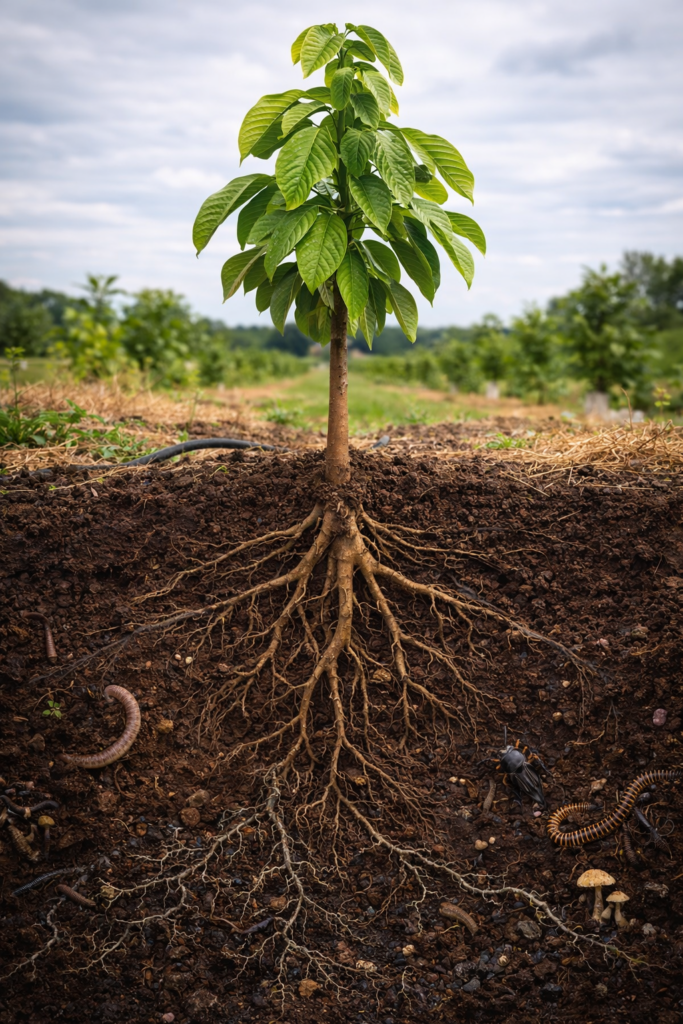
From the outset, our farm is being established using a no-till approach, with the goal of minimizing soil disturbance as the perennial system takes shape. Rather than relying on repeated mechanical disruption, we focus on protecting soil structure and allowing biological processes to develop naturally over time—an approach well suited to long-term perennial systems in the Upper Midwest.
Because tillage can disrupt soil aggregates, fungal networks, and microbial communities, reducing disturbance is a key part of how we support long-term soil function. As a result, roots, microbes, and organic matter are able to work together to build structure, improve nutrient cycling, and increase resilience as the farm matures.
In addition, our soil management emphasizes biological activity rather than short-term correction. While early establishment required some conventional inputs, our long-term intent is to rely more heavily on biologically driven practices, including foliar nutrition, microbial support, and reduced reliance on disruptive interventions. This allows the soil to function as a living system rather than a medium that must be reset each season.
Over time, healthy soil biology supports stronger root systems, improved nutrient availability, and more consistent plant performance across the farm. This is especially important for long-lived perennial crops such as Pawpaw, Elderberry, and Black Currant, which depend on stable soil conditions as they mature year after year.
By prioritizing reduced disturbance and biological function, we are creating the conditions needed for the entire agroforestry system to strengthen over time. These choices are not about speed or shortcuts, but about building soil health in a way that supports long-term productivity and resilience across the farm.
The health of the soil beneath the surface plays a defining role in how the entire system performs over the long term.
Water-Efficient Irrigation & Resource Use
Because water is one of the most limiting resources in perennial agriculture, our farm is designed around water efficiency rather than volume. From the beginning, irrigation decisions have been made to support long-term soil health, reduce waste, and deliver water only where it is needed most.
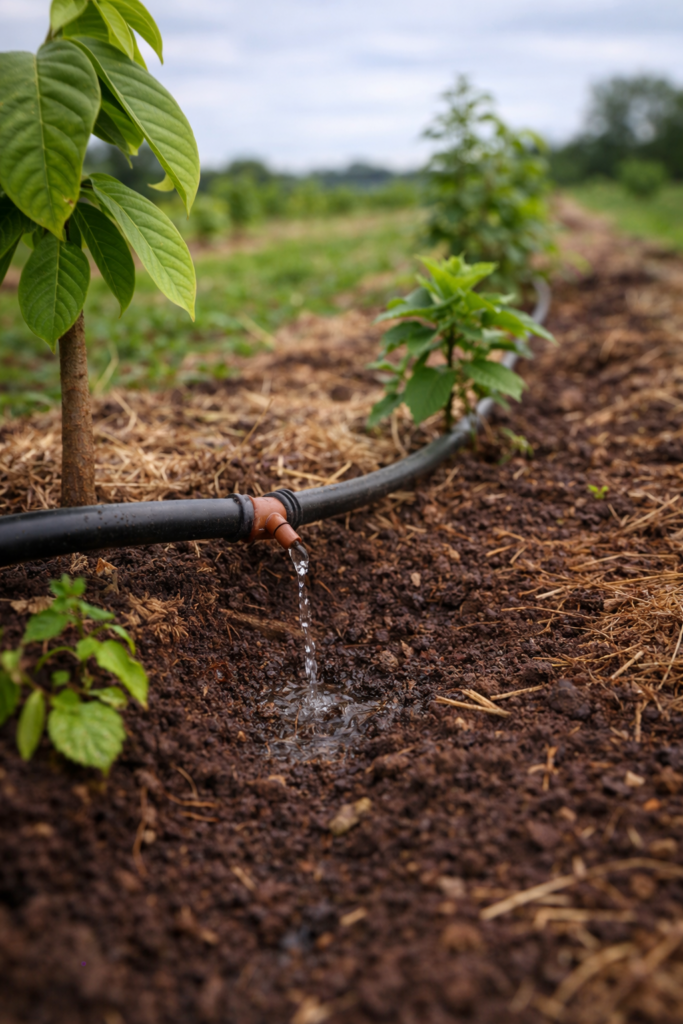
Instead of relying on overhead systems that lose water to evaporation and runoff, we are implementing micro-irrigation throughout the farm. This approach allows water to be applied slowly and directly to the root zone, improving absorption while minimizing loss. As a result, soil moisture is maintained more consistently, even during dry periods common across the Upper Midwest.
In addition, water efficiency is closely tied to the soil practices outlined in earlier sections. Permanent living ground cover and reduced disturbance improve infiltration and water-holding capacity, allowing rainfall and irrigation to work together rather than compete. Consequently, the irrigation system is designed to complement the soil rather than compensate for its loss of structure.
Because our farm includes a wide range of perennial crops at different stages of establishment, irrigation needs vary over time. Young plantings require more targeted support, while mature trees and shrubs become increasingly resilient as root systems develop. This adaptive approach allows the system to evolve alongside the farm, supporting crops such as Pawpaw, Hazelnut, and Seaberry as they mature.
Ultimately, efficient water use supports more than just plant growth. It reduces energy demand, protects soil structure, and strengthens the long-term resilience of the farm. These choices reflect a broader commitment to designing systems that function responsibly within our local climate and water resources, rather than relying on excess inputs to solve structural problems.
Ripening windows vary by year and growing conditions. Availability depends on weather and natural variation between trees.
Don’t Miss a Single Bite
Follow our:
👉 Events Page
👉 sign up for our newsletter
👉 watch our Facebook page for harvest updates.
The season is short—but the flavor memories last all year.
Carbon Capture & Climate Resilience
Agroforestry systems store carbon because they’re built on long-lived trees and shrubs, deep root systems, and reduced soil disturbance. Based on our i-Tree planting model for Brodhead, WI, our farm is projected to sequester ~32,235,982 pounds of CO₂ over 40 years (about 16,118 tons). In addition, the same model estimates measurable air-quality benefits over that timeframe, including approximately 138,273 pounds of ozone (O₃) removed, 9,740 pounds of NO₂ removed, 324 pounds of SO₂ removed, and 6,973 pounds of fine particulates (PM2.5) removed.
Perennial Biomass
Perennial trees and shrubs store carbon above ground as they grow and mature over decades. Unlike annual crops that are replanted and removed each season, woody perennials continue accumulating biomass year after year. This allows carbon to remain locked into trunks, branches, and long-term growth rather than being released back into the atmosphere through repeated disturbance.
As the farm develops, increasing canopy and woody structure contribute steadily to long-term storage, forming one of the most visible climate benefits of an agroforestry system.
Soil Carbon & Root Systems
Below the surface, extensive root systems play an equally important role in carbon storage. Living roots feed soil organisms, contribute organic matter, and support the gradual buildup of soil carbon as biological activity increases. Because soil disturbance is minimized, this carbon is more likely to remain protected within soil aggregates rather than being rapidly oxidized and lost.
Over time, improved soil structure and biological function allow carbon to accumulate slowly but persistently, strengthening the foundation of the entire system.
System-Level Resilience
Carbon capture is closely tied to broader climate resilience. Deeper roots improve water infiltration during heavy rainfall, while permanent ground cover helps reduce erosion and moderate soil temperatures during heat and cold extremes. Together, these factors reduce stress on crops and improve system stability across variable conditions.
By designing the farm as an integrated system rather than a collection of short-term practices, resilience emerges naturally alongside long-term carbon storage.